
Part of the fun of owning a home is being able to improve it – make it better. And in my own opinion for the money there isn’t any home improvement you can do that is better than adding a water softener system (sometimes call water treatment systems).
That about everything (and everyone) that water touches and everything that uses water in a home. A water softener system will make all of that better, and substantially so. And a well maintained water softener system will hold much of it’s value when it comes to selling your home (as opposed to a home without one).
I know, I know – a water softener is not an improvement that presents immediate visual, tactile impact like paint, new flooring or granite countertops. But we’re talking the difference between aesthetic improvements and functional ones. So while it’s possible that not everyone will appreciate that fuscia accent wall you painted in the living room it’s a definite that everyone and everything that comes into contact with water in your home will benefit from a water softener system.
And before anyone says, “I don’t like soft water because it feels like the soap never rinses off or the water feels slimy”, this is one of those instances where “feel isn’t real”. In other words, it’s hogwash. Softened water has a much higher lubricity than hard water. Lubricity refers to a substance’s abilty to reduce friction between moving surfaces. Water is a lubricant after all. So soft water is basically a much higher quality lubricant that hard water. So when you shower in soft water and after you wash away all of the soap, dirt and contaminants on your skin, you have clean skin with a high quality lubricant (soft water) in between. So your skin feels “slippery”. And it is, due to being clean and in the presence of soft water. Not because the soap didn’t rinse off.
So let’s dive in and talk about what hard water is and why it is bad, how water softeners remove it, and how a house and it’s occupant benefit from it!
What is hard water?
Simply, hard water is water that has a high concentration of minerals, specifically magnesium and calcium. Hard water is formed as groundwater filters and percolates through limestone, chalk and gypsum deposits. And the greater Houston area has historically had very hard water.
Why is hard water considered bad?
- Hair can feel brittle, and skin dry and itchy since hard water can strip away the body’s natural oils that keep hair and skin soft and supple.
- Soap is less soluble in hard water and develops less lather. Undissolved bits of the soap cling to the minerals in the water (forming what’s called “curd”) and these cling to surfaces like shower walls and sink basins and form soap scum. This also clings to your skin and can clog pores and lead to an itchy, scaly feeling.
- Minerals can build up in pipes, water heaters, dishwashers, etc.. Leading to reduced flow rate, decreasing appliance efficiency, higher energy bills and shorter appliance life.
- Clothes can feel stiff and appear faded or gray from mineral deposits.
What are the benefits of soft water?
- Softer skin and hair. Soft water helps prevent dryness, itchiness and irritation.
- Less residue left on skin means fewer clogged pores, helping reduce skin issues such as acne and eczema.
- Since soap will rinse away better from you and other surfaces, cleaning becomes easier as less soap scum will build up on shower walls and glass, sinks and associated fixtures.
- Soap will clean more effectively since it will lather easier, and you will save money because you will need less soap to produce an effective lather.
- Soft water helps prevent white streaks on glassware and cutlery.
- Clothes will feel softer and look brighter.
- Appliances that use water (dishwashers, washing machines, water heaters) will last longer with no more limescale buildup.
- Plumbing will be protected from mineral deposit buildup, preventing expensive repairs and helping maintain good flow rates at fixtures.
How do water softeners work?
While there are more than one type of water softener systems available, for the purposes of this blog piece we will focus on the type that is most prevalent in residential homes – sodium based water softeners.
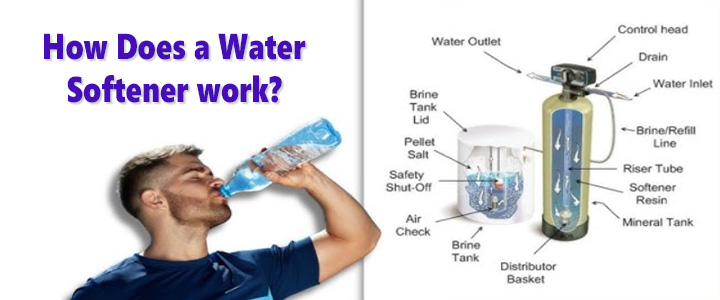
Sodium based water softeners work on the principle of ion exchange. Calcim and magnesium ions in the water (our hard water minerals) are exchanged with sodium ions, which don’t cling to pipes or react negatively with soap. While the process does add sodium to the water, the amount is minimal – less than 12.5 mg per 8 oz glass. By contrast, the U.S. Dept. of Health and Human Services estimates that the average American consumes around 3,400 mg of sodium per day from the food we eat. That said if you are considering a water softener system but are concerned about the sodium introduced you should consult a physician.
The ion exchange takes place in a tank filled with small resin beads. The beads carry a negative electrical charge. Sodium ions are positively charged and cling to the beads. As water flows past and around the beads, the calcium and magnesium ions, which carry a stronger positive charge, displace the sodium ions from the beads and themselves cling to the beads. Thus the ion “exchange”.
Over time, all of the sodium ions on the beads will have been replaced with the calcium and magnesium ions and when this happens the units stops softening the water. At this point the system needs to be “regenerated”. In a regeneration cycle, the beads are soaked in a very strong solution of water and sodium chloride salt – basically a strong brine solution. The sheer amount of sodium in the brine overwhelms the calcium and magnesium ions and they give way, and are again “exchanged” with the sodium ions which then cling to the beads. The system then flushes the brine solution containing the now suspended calcium and magnesium ions out through a drainpipe. A single regeneration cycle can produce around 25 gallons of salty water. Most modern water softener systems use electronic timers or onboard computers to automate the regeneration process. The brine tank is maintained by the regular addition of salt crystals or pellets. These come in 40lb bags that can be easily found at Home Depot, Lowes, Walmart, Target, etc.. and currently run around $7 – $8 per bag. Depending on home size and water use you can expect to use anywhere from 12-20 bags per year.
Water softener system cost
For equipment only, on a good, better, best comparison, a “good” system can be had for around $1,000 or maybe a little less. A “better” system can be had starting around $1,200 – $2,000, and a “best” system anywhere from $2,000 up to $5,000 or more. Installation costs can vary greatly depending on how water is delivered to and enters the home.
Summary
Of all the upgrades and investments you can make in a home, in my opinion nothing beats a water softener for all of the benefits it provides. If I were to buy a house and have anywhere from $1,000 to $2,500 to invest in an upgrade the first thing I would do is add a water softener system. Properly maintained they will last for years and add real value to a home when it comes time to sell. They extend the life of appliances, reduce maintenance costs for the home overall, help improve the the appearance of skin and clothes. I see no downsides to have an in home water softener system.
#actionableintelligence #informeddecisions #watersofteners #waterquality