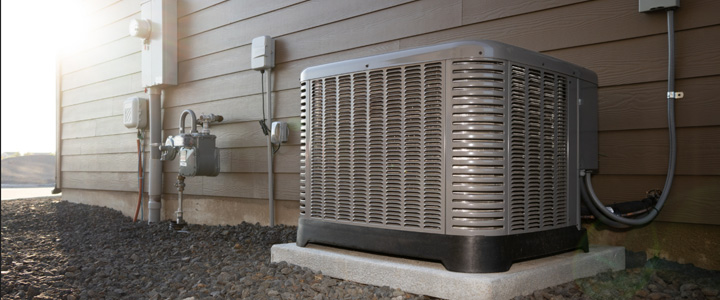
Your home’s heating and air conditioning system – otherwise known as the HVAC system – is one of the most important systems in a home. It helps keep the home livable from a comfort standpoint and also plays an important part in humidity control.
So with that in mind this post is going to cover some important information you should know if you are considering buying a house with an existing HVAC system, or currently own a home with an older system. Let’s go ahead and jump in.
Understanding the right size system for your home
HVAC system capacity is measured in tons. So you may see references to a “2 ton system, or 3.5 ton system…” Great. But what does that mean?
So glad you asked! 1 ton of cooling capacity is equal to 12,000 BTU’s (British Thermal Units). Clear as mud now? Going further 12,000 BTU’s (one ton) is the amount of heat needed to melt one ton of ice in 24 hours.
So if you see on an AC condenser unit label where it says “42,000 BTU’s” then you know you have a 3.5 ton capacity system (42,000/12,000 = 3.5).
Ok, but is this going somewhere? You still haven’t told me how to determine the right size unit for my house!
You are so right and we’re going to get to that right now. So there are a couple of ways to go about this.
The best and most accurate way is to hire a professional to do what is called a Manual J load calculation. They will take a number of factors into account – Square footage, ceiling height, insulation type and level, heat producing appliances, etc… Using this data they will then calculate the correct system size for the home.
Another method is to use a “rule of thumb” calculation. For this simply take the square footage of the home and multiply by 20 BTU’s. So for example, a 2000 sq ft home you would take 2000 x 20 = 40,000 BTU’s. Divide by 12,000 BTU’s (one ton of cooling) and you get 3.333. So you could assume a 3.5 ton system for this home as a basic or ballpark estimate. This can give you some idea of cost but as always, consult an HVAC professional before deciding on size.
Getting the right system size in place is important. If you install a system that is too large, i.e. too much capacity, you will experience what is known as short-cycling. This is a condition where the HVAC system will cycle on and off frequently. This can lead to premature wear on components, higher energy bills, poor humidity control and inconsistent temperature control.
Conversely, installing a system that is too small – not enough capacity – is also not desirable. If too small it will constantly run seeking to reach a temperature it’s not capable of sustaining. This will also lead to higher energy bills and shortened lifespan of the system. Unevenly heated or cooled rooms can also result.
Understanding system efficiency
If you shop for a new HVAC system you are likely to see them advertised with their SEER rating. SEER stands for Seasonal Energy Efficiency Ratio. This is a ratio of how efficiently an AC system operates over an entire cooling season. The higher the number the more efficient the system.
SEER is calculated by dividing the total cooling output (BTU’s) by the total energy input (watt-hours) over a season (cooling input (BTU’s) / energy input (watt-hours)).
So SEER is great right? Apparently so because now a new efficiency standard called SEER2 has been introduced that is supposed to be based on more real world conditions. As a result it’s ratings are slightly lower than regular SEER ratings. The takeaway here is to be careful to do apples-to-apples comparisons and don’t compare the SEER rating of one system to the SEER2 rating of another.
Lastly, keep in mind is SEER/SEER2 are indicators related to the efficiency of the AC component of an HVAC system. Someone who lives in Texas or Florida might place more value on the SEER rating of a system than someone who lives in a more cool, northerly climate. This is important because in general, the higher the SEER rating of a system, the more expensive it becomes.
Understanding refrigerant types
This is an important section of this blog piece if you are considering purchasing an older home with an existing HVAC system. The type of refrigerant in use can give you some insight into what ongoing maintenance costs will be.
R-22. Better known by it’s trade name “Freon”, R-22 was widely used in HVAC systems for years before being banned from manufacturing and import into the U.S. on Jan. 1, 2020. This was due to it containing chlorine, which damages the Earth’s ozone layer. Systems with R-22 can still be maintained and recharged, but only with recovered/reclaimed R-22. This has caused the cost to rise to between $100 – $250 per pound installed. Most cooling systems require 2-4 pounds per ton of capacity. You don’t have to be a mathematician to understand this gets expensive, fast. If you are considering the purchase of an older home with an HVAC system that uses R-22, you should budget for it’s replacement sooner rather than later.
R-410A. Trade name “Puron”. Introduced into HVAC manufacturing in 1996, it became the industry standard in the U.S. and EU in 2010, replacing R-22. While more ECO friendly than R-22 it was still considered to have a high global warming potential as global regulations became stricter. As a result, beginning Jan. 1, 2025 the U.S. banned the importation of R-410A based HVAC equipment into the country. You can still recharge R-410A based HVAC systems but it should only be done by an EPA certified technician due to legal and safety requirements. Further if a system has a low charge due to a leak, you may be required to have the leak located and repaired before any recharging will be done. Installed cost for R-410A can run anywhere from $40 – $90 per pound but expect these costs to continue to rise as these systems age out. If you are considering the purchase of a home that has an R-410A based system you should begin budgeting for it’s eventual replacement.
R-454B and R-32. These are the replacement refrigerants for R410A. R-454B is intended as the primary replacement for R-410A in most ducted, whole house systems while R-32 will be used primarily in ductless mini-split systems. If you are considering the purchase of a home with an HVAC system that uses either of these refrigerants, you can confidently focus on routine maintenance items as these refrigerants will be in use for the foreseeable future.
A word about filters
Just as keeping the oil changed regularly on your car is the most important maintenance item, making sure you change your HVAC filters regularly is the single most important maintenance item you can do to ensure the longest life possible for your HVAC system.
Clogged, dirty air filters can shorten the life of an HVAC system considerably. You are literally choking off the system’s air supply which makes it that much harder for the blower motor to draw air in to blow over the evaporator coils. Plus when filters get clogged the blower pulls a lot of that excess dirt and particles into the blower compartment where it gets into the blower assembly and “fouls up the works”.
And so, this then is the most important function of the air filter in an HVAC system – to protect the equipment. That might come as a surprise to many because if you browse the aisles of your local Home Depot or Lowes for HVAC filters you couldn’t be blamed for thinking the idea of those filters is to protect the occupants.
Why is that? Because the packaging of these filters is covered in statements like, “traps the following allergens XXX”, “traps pet dander”, and any manner of statements that could make one think that the purpose of the filter is to improve indoor air quality. And it’s not. It’s to protect the equipment. Period. And if those filters do trap allergens and pet dander and it results in better air to the occupants then it’s an ancillary benefit. Not the main one. PROTECT THE EQUIPMENT.
So my personal advice is to install less expensive, basic filters and change them regularly. If you are concerned about indoor air quality consider adding stand alone air filtration units to your home.
#actionableintelligence #informeddecisions #hvachealth #hvacfactsisions #sewerrepair #sewerproblems #sewerinspection #sewerscope