
What is Radon and why should you get a Radon test?
Radon is a radioactive gas that is produced by the natural decay of uranium found in soil, rock, and water throughout the United States. It moves up through the ground to the air above and can enter your home through cracks or other holes in your foundation, where it can get trapped inside your home. Radon is odorless, colorless, and tasteless.
Radon is dangerous to human health, because as it decays, it produces radioactive particles that can be inhaled and are hazardous to human lung tissue. In fact, Radon is the second leading cause of lung cancer in the U.S. (after smoking), with the Environment Protection Agency (EPA) estimating in 2003 that Radon causes 21,000 deaths per year from lung cancer! From the same study this is more than for deaths caused by Drunk Driving (17,400), and the combined totals of Falls in the Home (8,000), Drownings (3,900), and Home Fires (2,800)!
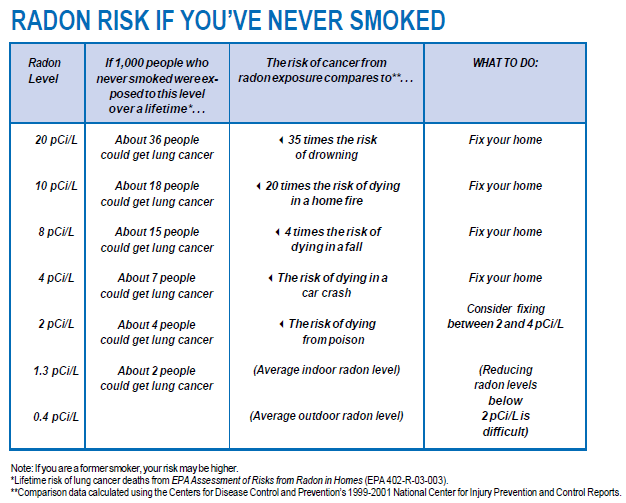
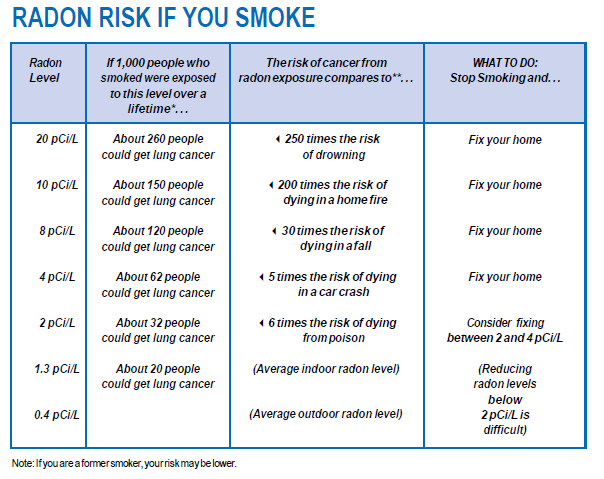
Radon is measured in Pico Curies per Liter (expressed as pCi/L). The EPA has fixed the average outdoor Radon level at 0.4 pCi/L, and the average indoor Radon level to be 1.3 pCi/L. The EPA considers an indoor level of 4 pCi/L and higher to be “elevated” and is the point where they recommend that mitigation steps be taken to reduce that level, with a goal to get the level to 2 pCi/L or lower.
Radon levels in a home between 2-4 pCi/L, while not considered elevated, are still high enough that the EPA says a homeowner should “consider” taking steps to lower this level. There is no known safe level of Radon exposure.
Radon concentration can’t be predicted. For example, if a home next to yours had a recent Radon test that revealed lower levels of Radon, this is no guarantee that your home would produce the same result. Radon concentration is very location dependent on a micro scale. The EPA estimates that one in every 15 homes has elevated Radon levels (4 pCi/L and higher) in the U.S., and elevated Radon levels have been detected in all 50 states.
To put the risk of getting lung cancer from Radon into some perspective, here are two tables reproduced from the EPA’s own A Citizen’s Guide to Radon
How do we test for Radon?
There are two types Radon testing available – Long Term (91 days to 1 year), and Short Term (2 – 90 days). Generally speaking, it is assumed that the longer the test period, the more accurate the result.
Long Term testing.
Long term tests for Radon are longer than 90 days and up to a year. This type of testing is normally used as a follow up measurement after an initial short-term test that resulted in a Radon concentration between 4 pCi/L to 8 pCi/L. Long term measurements exposed for a whole year are the best way to determine the annual average Radon concentration under normal living conditions.
Short Term testing
Short term tests for radon are between 2 and 90 days in duration. This is the most used method of testing in the Radon test industry, especially in real estate transactions where testing and inspection windows are short. Short term tests are used as an initial test to quickly determine if the Radon levels are high enough to warrant further action.
Short term tests cannot be less than 48 hours in order to be considered a certified result. The minimum allowable measurement period is 48 hours for all short-term measurements.
Radon Testing Devices
Continuous Radon Monitor (CRM) (Long term/short term)
A CRM is an active (powered) Radon monitor that produces continuous results over time. For example you are able to compare results for a one week period over another. At the end of the test these results can be averaged to determine the average Radon level over the test period.
The drawback to CRM’s is cost. The equipment is expensive both to acquire and maintain and as a result, testing done with CRM’s tends to cost more than testing done with other (approved) devices.
Alpha Track Detectors (Long term/short term)
Alpha Track detectors are passive devices that contain a specially treated plastic chip or cellulose film. As Radon gas enters the detector, it decays and the decay products impact the chip or film and leave microscopic scars on this material. At the end of the test period the chip or film is analyzed under a microscope and the number of impacts is measured. This measurement along with the length of the test period is used to calculate the average Radon level for the test period.
Electret Ion Chambers (Long term/short term)
Electret Ion Chambers are passive devices that use a bottle like device constructed from a special electrically conductive plastic. It contains a charged Teflon coated disc, called an electret. Exposure to Radon and it’s decay products degrades the charge on the electret. At the end of the test period the change in charge is measured and used to produce the average Radon level for the test period.
Activated Charcoal Canisters (Short term only)
Activated Charcoal canisters are the most common type of passive Radon testing device. Charcoal canisters work by letting Radon gas in which settles on the surfaces of the charcoal. As the Radon decays, it’s decay products are left behind on the charcoal. The amount of decay products measured by the lab, factored in with the exposure time allows for determining the average Radon level for the test period.
Charcoal canisters are by far the most common used during testing in a real estate transaction. Why? Cost and time. Charcoal canisters deliver accurate, reliable results in the shortest amount of time possible. Testing can be done with as little as 48 hours of actual exposure time, plus the time for lab processing. And charcoal canisters are also the most cost effective, being the least expensive testing medium which allow inspectors to keep costs under control.
Testing Protocol
Any Radon test done by a reputable inspector/tester is going to conform with the guidelines set out by the EPA in their guides the Home Buyer’s and Seller’s Guide to Radon, and A Citizen’s Guide to Radon. You can find out more at www.epa.gov/radon.
There are multiple scenarios each requiring a different protocol, but for this blog piece we are going to focus on short term testing in a time sensitive real estate transaction. This is a very common scenario in buying/selling a home.
Here’s what we will do:
- Establish closed building conditions.
- 12 hours prior to the test, all windows closed on every level of the home during the test and doors opened only long enough for normal entry and exit if testing period is between 2-4 days.
- All windows to remain closed on every level of the home during the test, and doors opened only long enough for entry and exit until completion of the test.
- Internal-external air exchange systems (other than the furnace), such as a whole house fan, window fan, or fresh air setting on a window air conditioner should not be operating.
- Air conditioning systems that recycle interior air and permanently installed heat recovery ventilators may be operated.
- Ventilation equipment that brings outdoor air into the house shall not be operated unless it is a necessary component such as make-up air for an operating combustion appliance.
Once this is done we will conduct the test:
- We will conduct two short term tests simultaneously, at the same time, in the same location for at least 48 hours. The location will be in the lowest level of the home that could be used or lived in regularly.
- The results from both devices are then averaged to produce a single average.
For example: Test 1 = 4.2 pCi/L
Test 2 = 4.6 pCi/L
Average of both = 4.4 pCi/L
If the higher of the two test results is greater than double the lower result, the test is considered invalid and should be performed again.
Non-Interference Agreement
Prior to testing we ask the owner/occupant to sign a non-interference agreement. It is an agreement where they agree to maintain EPA defined closed building conditions for the duration of the test and not interfere in any way with the test devices.
Interfering with these devices during a real estate transaction can constitute fraud and can expose a person to legal consequences.
At Gumshoe Property Inspection LLC, signing this agreement is mandatory. If the owner/occupant refuses we will not conduct the test. Any fees already paid will be refunded.
Pricing and Availability
Current pricing for our Radon testing can be found on our website here. Radon testing is available as an add on service with a home inspection or as a standalone service. We give a discount when bundling with a home inspection.
Radon testing is available with any home inspection, however given the usually tight time windows when inspections can take place we need to know this as soon as possible in the process. While we always do our best to provide results as soon as we get them, there are certain things in Radon testing that are either non-negotiable or outside of our control; the 12 hour closed building requirement prior to testing, the 48 hour test period, and the time needed for lab processing and report generation.
In Summary
Radon gas is harmful to human health and is the second leading cause of lung cancer deaths in the U.S. after smoking. Since Radon is odorless, colorless and tasteless, it’s presence and quantity can only be confirmed by testing with special devices by qualified personnel.
If you are considering the purchase of a home, it is in yours and your family’s best interests to get a Radon test done to establish what the exposure risk is, and what steps if any need to be taken to minimize them.
If you have any questions don’t hesitate to reach out to us at 713-424-1411 or drop us a line at br****@***************on.com.
#actionableintelligence #informeddecisions #radontesting