
History
Aluminum, as most people know, is an excellent conductor of electricity. It’s light weight and lower cost compared to copper has made it the favored way for electric utilities to transmit power and deliver it to homes since the turn of the 20th century. There is a very good chance that the service entrance conductors in your main electrical panel right now are aluminum, even if it is a newer home.
Historically, once the utility delivers the service to the home, the branch circuits (individual circuit wiring) have been copper. However there was a period from the 1960’s to around the mid-1970’s when copper prices were quite high. Home builders went looking for an alternative and in many cases switched to solid conductor aluminum wiring for the branch circuits. And while it worked, after a short period the law of unintended consequences kicked in and problems began to emerge.
The Problem
While both copper and aluminum are excellent electrical conductors, aluminum differs in that it expands and deforms as the material heats up under electrical load, and then contracts when the load is removed (the circuit or appliance is switched off for example). This is a condition known as “cold flow” or “cold creep”. Since branch circuits (lighting circuits, outlet circuits, appliance circuits) are not always in use, the aluminum wiring is subjected to many cycles of this. Over time this results in loose connections and overheating at circuit breakers, light switches, electrical outlets, and inside junction boxes where splice connections (wire nuts, crimps, etc..) reside.
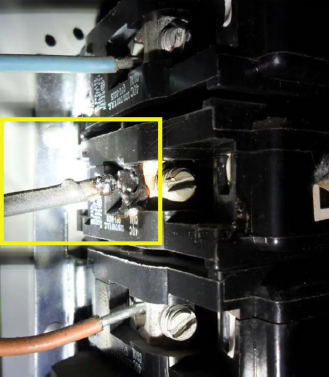
Loose connections like this can cause problems from the inconvenient (wonky behavior of lights, outlets and appliances) to the downright dangerous (arcing and fires). Here’s some proof.
Aluminum wiring arc damage at circuit breaker:
Aluminum wiring overheating in junction box:

It’s worth pointing out a home inspector should catch issues like the arcing evident at the circuit breaker since inspectors are required to remove the cover to the main panel during an inspection.
But inspectors are not required to examine the inside of switch boxes and outlet boxes or junction boxes during an inspection so damage like the one above in the junction box would likely go undetected.
What to do if you have aluminum wiring
If the inspection report reveals the presence of solid conductor aluminum branch wiring, you have a few options. Let’s go over them here in order of most-to-least preferable.
Rewire the home
This is the best long term solution – replace all aluminum branch circuits with copper wiring. It is also the most expensive. But it does add resale value to the home compared to other aluminum wired houses and brings it into compliance with current NEC standards.
Add AlumiConn refit connectors
AlumiConn connectors are special connectors that allow for attaching (pig-tailing) short sections of copper wire to the ends of the solid aluminum conductors. These copper wires are what is then connected to receptacles and switches.
AlumiConn connectors are UL listed. While this method is less expensive that rewiring an entire house, it is not necessarily cheap. AlumiConn connectors currently run around $4.25/ea so depending on the size of the house it can be spendy. Also, these should only be installed by a licensed electrician with experience installing them. These are not a DIY project.
CO/ALR receptacles and switches
These are receptacles and switches specially designed to accept solid aluminum wire. It is considered a less desirable option however. Not many companies make these devices so selection and availability can be limited. And despite being designed specifically to accept aluminum wire, they still provide less long-term reliability compared to re-wiring or using AlumiConn connectors.
Purple wire nuts
There are some purple colored wire nuts that are advertised for use connecting aluminum-to-copper wiring. However they are not UL listed and are suspected as being at fault in numerous electrical fire investigations. They are also not considered a safe solution by the Consumer Product Safety Commission (CPSC). We cannot recommend their use in any way.
Do nothing and hope for the best
This is written somewhat tongue in cheek because in our opinion, unaddressed aluminum wiring in homes is too dangerous and not a condition you should allow to continue. Our advice is to pick the best option above that you can afford and do it.
A word about insurance
Any homes built with aluminum branch wiring will be a minimum of around 50 years old at this point. Many insurance companies may ask to see a copy of the inspection report before issuing a quote because among other things, they want to see what type of wiring is used in the house. This helps them assess the risk of insuring the house and determining what rate they quote you. So it may be worthwhile to ask your insurer what remediation of the aluminum wiring will return the lowest rate and make decisions based off of that.
#actionableintelligence #informeddecisions #homeinspection #houstonhomeinspection #electricalsafety #aluminumwiring